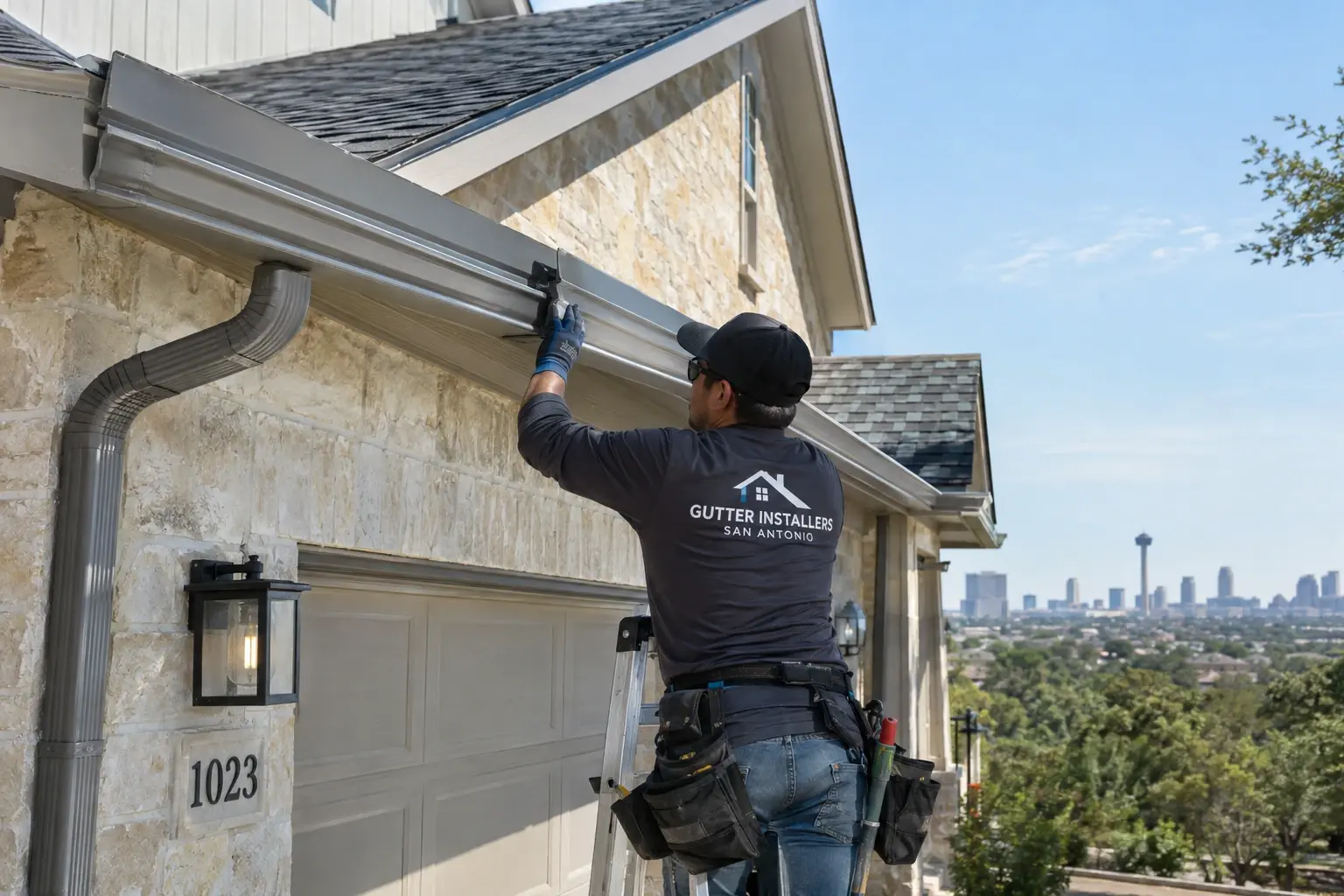
Reviewed by the Gutter Installers San Antonio teamUpdated
Professionally installed gutter guards in San Antonio typically cost $8–$25 per linear foot. Basic screens sit at the low end, while stainless steel micro-mesh runs about $12–$25 per foot. For homes under live oaks, pecans and Ashe juniper, micro-mesh blocks catkins, needles and small leaves best, though every guard still needs light cleaning once or twice a year.
| Typical installed cost | $8–$25 per linear foot |
|---|---|
| Stainless micro-mesh | $12–$25 per linear foot |
| Best for live oak and cedar | Stainless micro-mesh |
| Typical install time | 1 day for most homes |
| Maintenance | Light top-side cleaning 1–2x a year |
What are gutter guards and do they work in San Antonio?
Gutter guards are covers or inserts that let rainwater into the gutter while keeping leaves and debris out. They work well in San Antonio when the guard type matches the debris your trees drop. The wrong guard can actually make clogs worse.
San Antonio is a tough test for guards. Live oaks drop leaves, catkins and acorns. Pecans shed leaves, husks and nut debris. Ashe juniper, the local cedar, sheds fine needles year-round. Add shingle grit and the intense downpours that give Central Texas its "Flash Flood Alley" nickname, and you need a guard that both filters fine material and handles heavy flow.
What types of gutter guards are there?
There are four main types of gutter guards: micro-mesh, screens, reverse-curve (surface tension) covers, and foam or brush inserts. They differ in what size debris they stop, how much water they accept and how much upkeep they need.
| Guard type | How it works | Live oak / cedar debris | Pecan leaves | Typical installed cost |
|---|---|---|---|---|
| Stainless micro-mesh | Fine stainless mesh over a rigid frame filters out nearly everything | Best option; blocks catkins and needles | Very good | $12–$25/lf |
| Perforated or screen guards | Metal or vinyl screen with larger openings | Poor; needles and catkins slip through or lodge | Good | $8–$12/lf |
| Reverse-curve (surface tension) | Solid hood; water follows the curve into a slot | Fair; small debris can ride in | Good | Varies; often upper range |
| Foam inserts | Porous foam fills the gutter | Poor; fine debris and seeds embed in foam | Fair | Low; rarely recommended |
| Brush inserts | Bristle brush sits in the trough | Poor; needles and catkins tangle in bristles | Fair | Low; rarely recommended |
What are the best gutter guards for live oak, pecan and cedar trees?
For most San Antonio homes under live oaks or Ashe juniper, stainless steel micro-mesh is the best choice. Its openings are small enough to stop catkins, juniper needles and shingle grit, while a well-designed frame still accepts heavy rain.
- Live oak. The leaves are small and leathery, and the spring catkins form mats that clog screens. Micro-mesh keeps them on top, where wind and rain clear much of it.
- Pecan. Larger leaves and husks are stopped by most guards. Screens can work if no live oak or cedar is nearby, but micro-mesh is still lower-maintenance.
- Ashe juniper (cedar). Needles are the hardest debris to keep out. Screens, foam and brush guards all trap them. Micro-mesh is the only type we recommend under cedar.
- Cedar elm, Arizona ash, bur oak. Seeds and small leaves are handled well by micro-mesh. Large bur oak acorns sit on top of any guard and roll off.
We go deeper on this in our guide to the best gutter guards for oak and pecan trees, including what we see fail most often on local homes.
How much do gutter guards cost in San Antonio?
Professionally installed gutter guards in San Antonio typically cost $8–$25 per linear foot. Basic screens land near $8–$12 per foot, while stainless micro-mesh runs about $12–$25 per foot depending on the product, roof type and access.
| Gutter length | Basic screens | Stainless micro-mesh |
|---|---|---|
| 120 linear feet (smaller single-story) | About $960–$1,440 | About $1,440–$3,000 |
| 180 linear feet (average home) | About $1,440–$2,160 | About $2,160–$4,500 |
| 250 linear feet (larger or two-story) | About $2,000–$3,000 | About $3,000–$6,250 |
Guards should go on clean, sound gutters. If your gutters are sagging, leaking or undersized, it is usually smarter to address that first with gutter repair or new seamless gutters, then add guards. See our San Antonio gutter cost guide for full-project budgets.
Do gutter guards void your roof warranty?
They can, depending on how they attach. Guards that slide under the first course of shingles can break the shingle seal or require lifting shingles, which some roofing manufacturer warranties do not allow. Guards that attach to the front lip of the gutter, or to the gutter and drip edge without disturbing shingles, avoid that issue.
Under-shingle guards lift the first row of shingles. On composition roofs, that can loosen the adhesive strip that holds shingles down in high wind. We generally recommend guards that fasten to the gutter lip and sit at or below the drip edge, and we review your roof type and any warranty paperwork before recommending a product.
Tile and standing-seam metal roofs need extra care. Tile cannot be lifted without risk of cracking, and metal roofs shed water fast enough to overshoot some guards in a heavy storm. Both are workable with the right product and pitch.
Do gutter guards still need maintenance?
Yes. No gutter guard is truly maintenance-free. Even the best micro-mesh can collect a film of pollen, catkins and fine debris on top, which slows how fast water gets through during a downpour.
- Brush or rinse the top of the guards once or twice a year, typically after the spring live oak drop.
- Check that water enters the gutter during a heavy rain instead of sheeting over the front.
- Flush downspouts periodically, since fine sediment can still pass through.
- Inspect after hail or high wind, since dented frames and lifted mesh let debris in.
Compared with three or four full gutter cleanings a year under heavy tree cover, that upkeep is minor. If you want a recommendation for your specific trees and roof, request a free estimate.
Are DIY gutter guards from the hardware store worth it?
Inexpensive snap-in screens, foam and brush inserts are easy to buy, but they rarely hold up under San Antonio tree cover. They tend to trap the fine debris our trees drop, and once clogged they are harder to clean than an open gutter.
The most common problems we see with DIY guards are screens that pop loose in wind, foam that fills with seeds and sprouts, brush inserts tangled with juniper needles, and guards slid under shingles in a way that lifts the first course. Removing failed guards before a proper install adds time and cost.
DIY screens can be a reasonable stopgap on a single-story home under pecans or with no trees at all. Under live oak or cedar, a professionally fitted micro-mesh system is the setup that actually reduces maintenance.
Should gutter guards go on new or existing gutters?
Guards can go on either, as long as the gutters are sound, pitched correctly and fastened to solid fascia. Adding guards at the same time as new gutters is the cleanest result, because hangers, guard attachment and downspout outlets are all planned together.
On older systems, we check for loose hangers, leaking seams and soft wood first. If the fascia behind the gutter is rotted, it needs fascia and soffit repair before anything else gets fastened to it.
Can gutter guards handle heavy San Antonio rain?
Good guards can, as long as the gutter system itself is sized correctly. San Antonio averages roughly 32 inches of rain a year, but it often falls in short, intense bursts. If gutters overflow during heavy storms even when clean, the issue is usually gutter size or downspout capacity, not the guard.
Larger roofs and steep pitches often benefit from 6-inch gutters and 3x4 downspouts. Our guide to 5-inch vs 6-inch gutters explains when to size up, and our downspouts and drainage service covers moving that water safely away from the foundation.
Our Gutter Guards Process
Tree and roof assessment
We note which trees overhang the roof, the roof material and pitch, gutter size and condition, and how your current gutters handle runoff.
Guard recommendation and quote
You get a written quote with the recommended guard type, how it attaches and why it fits your trees and roof.
Clean and repair first
Gutters are fully cleaned and downspouts flushed. Loose hangers, leaking seams and pitch problems are corrected before guards go on.
Install guards
Guards are cut to fit, fastened to the gutter, and trimmed around corners, miters and downspout outlets without disturbing shingles where possible.
Water test and walkthrough
We run water across the roof edge to confirm flow into the gutter, then walk you through maintenance expectations.
Gutter Guards Service Areas
We provide gutter guards throughout San Antonio and the surrounding communities. Choose your area for local details:
- Alamo Ranch
- King William
- Leon Springs
- Medical Center
- Monte Vista
- Stone Oak
- The Dominion
- Timberwood Park
- Alamo Heights
- Boerne
- Bulverde
- Castle Hills
- Cibolo
- Converse
- Fair Oaks Ranch
- Garden Ridge
- Helotes
- Hill Country Village
- Hollywood Park
- Leon Valley
- Live Oak
- New Braunfels
- Olmos Park
- Schertz
- Selma
- Shavano Park
- Terrell Hills
- Universal City
- Windcrest
Gutter Guards FAQ
How much do gutter guards cost in San Antonio?
Professionally installed gutter guards in San Antonio typically cost $8–$25 per linear foot. Basic screens fall near $8–$12 per foot, and stainless steel micro-mesh usually runs $12–$25 per foot. For an average home with around 180 feet of gutter, that works out to roughly $1,440 to $4,500 depending on the product and roof.
What is the best gutter guard for live oak trees?
Stainless steel micro-mesh is the best choice under live oaks. Its fine openings stop the small leaves, acorns and stringy spring catkins that clog screens and get tangled in brush and foam inserts. Expect to brush or rinse the top of the guard once or twice a year after the spring drop.
Do gutter guards work with cedar (Ashe juniper) needles?
Only fine micro-mesh reliably keeps juniper needles out. Needles slide through standard screens, embed in foam and tangle in brush inserts, which creates clogs that are harder to clean than an open gutter. Under cedar, micro-mesh with occasional top-side cleaning is the setup we recommend.
Will gutter guards void my roof warranty?
They can if they are installed under the shingles. Guards that require lifting the first course of shingles may break the seal strip, which some manufacturer warranties do not allow. Guards that fasten to the gutter lip and sit at or below the drip edge avoid that issue. We check your roof type before recommending a product.
Do gutter guards eliminate gutter cleaning?
No. They reduce it substantially, but fine debris and pollen can collect on top of any guard. Plan on brushing or rinsing the guards once or twice a year and flushing downspouts occasionally. That is still far less work than three or four full cleanings a year under heavy tree cover.
Can you install gutter guards on my existing gutters?
Usually, yes, if the gutters are in good shape and pitched correctly. We clean the gutters, flush downspouts and fix loose hangers or leaking seams before installing guards. If gutters are sagging, rusted or undersized, replacing them first is often the better long-term value.
Do gutter guards work on tile and metal roofs?
Yes, with the right product. On tile roofs we use guards that attach to the gutter without lifting tiles. On metal roofs, which shed water quickly, we confirm the guard and gutter size can capture fast runoff during heavy rain so water does not overshoot the gutter.
Gutter Guards Guides for San Antonio Homeowners
- Best Gutter Guards for Live Oak and Pecan Trees in San Antonio
- Gutter Maintenance Schedule for San Antonio Homes (Month by Month)
Related Services
Gutter Cleaning
Hand-cleaned gutters, flushed downspouts and photo-documented results, timed around live oak and pecan season.
Learn more →Seamless Gutters
Continuous aluminum gutters formed in our truck at your home, cut to the exact length of each roofline.
Learn more →Gutter Repair
Leaking seams, sagging runs, loose downspouts and rotted fascia fixed right, so your gutters work in the next storm.
Learn more →Downspouts & Drainage
Properly sized downspouts and underground drain lines that carry roof water away from your slab foundation.
Learn more →