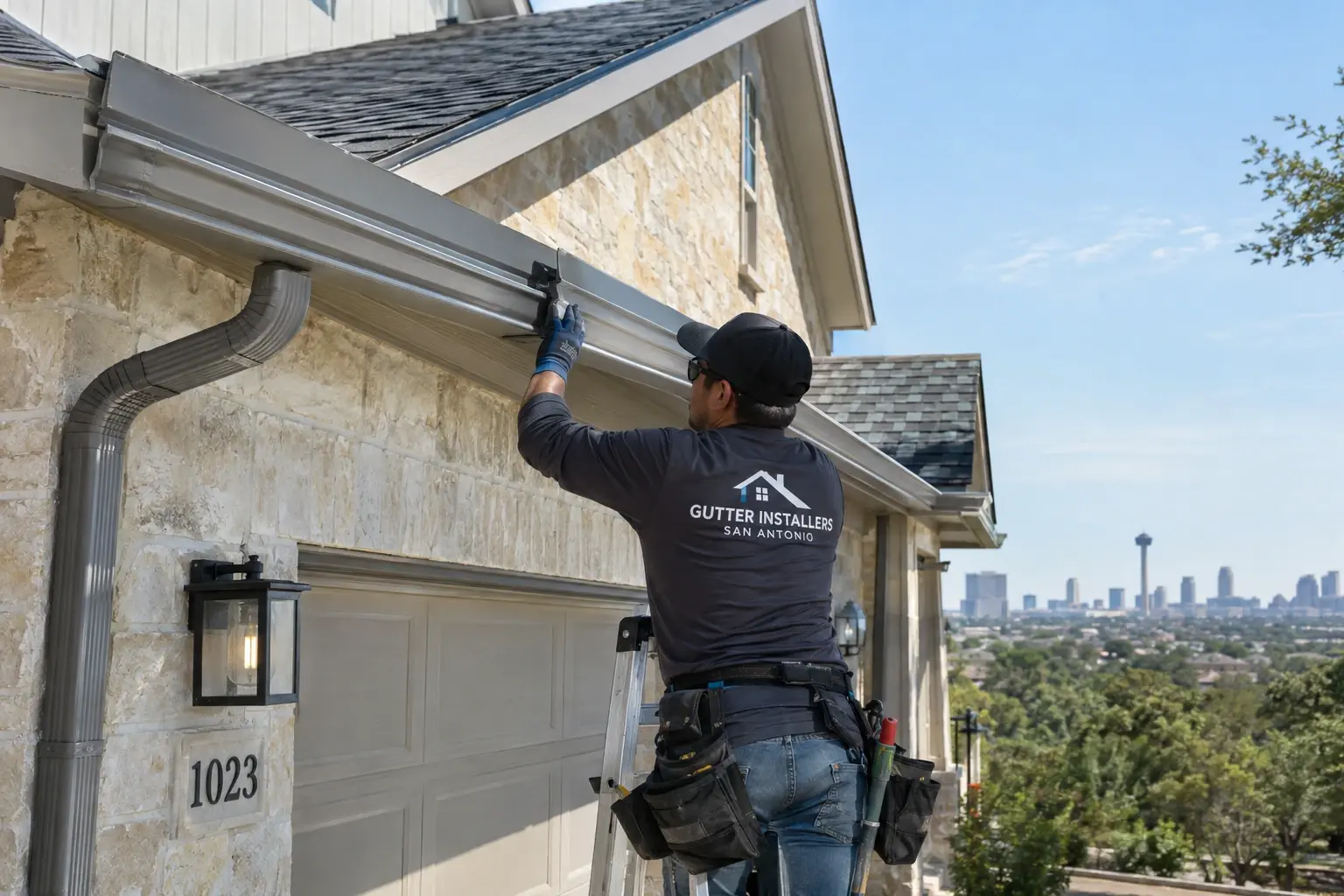
Reviewed by the Gutter Installers San Antonio teamUpdated
Most gutter repairs in San Antonio cost $150–$650 per visit. Common fixes include resealing leaking end caps and corners, replacing loose or broken hangers, re-pitching sagging runs, reattaching downspouts, and replacing rotted fascia behind the gutter. If problems are widespread or the gutters are old sectional or vinyl, replacement is often the better value.
| Typical cost | $150–$650 per repair visit |
|---|---|
| Fascia replacement | About $8–$20 per linear foot |
| Project time | 1–4 hours for most repairs |
| Common fixes | Leaks, sagging, hangers, downspouts, fascia |
| Warranty | Workmanship warranty included |
| Service area | San Antonio + 30-mile radius |
Gutter repair means fixing the specific part of a gutter system that has failed, such as a leaking corner, a sagging section, a loose downspout or a rotted fascia board, without replacing the whole system. Most problems we see in San Antonio come from a handful of causes: old sealant cracking in the heat, hangers pulling out of soft wood, gutters overloaded with oak debris, and hail or wind damage.
We diagnose why the problem happened before fixing it. Resealing a corner that leaks because the gutter is pitched backward only buys a few weeks.
How much does gutter repair cost in San Antonio?
Most gutter repairs in San Antonio cost $150–$650 per visit. Simple resealing or a few hangers sits at the low end; re-pitching long runs, replacing a downspout or fixing several problems at once sits toward the top. Fascia replacement is priced by the foot.
| Repair | Typical price |
|---|---|
| Reseal leaking end caps or corners | Low end of $150–$650 |
| Replace loose or broken hangers | $150–$650 depending on footage |
| Re-pitch a sagging or backward-sloped run | $150–$650 |
| Reattach or replace a downspout | $150–$650; new downspout $8–$14 per lf |
| Fascia board replacement | About $8–$20 per lf (typical job $250–$1,200) |
| Replace a damaged gutter section with seamless | $7–$15 per lf for the new run |
Your estimate will list each repair separately. If the repair total starts approaching the cost of new gutters on that side of the house, we will tell you, and show you the replacement price too.
Why are my gutters leaking?
Gutters usually leak at joints: end caps, corner miters, downspout outlets and the splices in sectional gutters. The sealant at those points dries out and cracks over time, especially in San Antonio heat, and standing water from poor pitch speeds it up.
- Failed sealant at corners and end caps: we clean the joint down to bare metal, re-rivet if needed and apply fresh gutter sealant.
- Leaking sectional splices: resealed, or replaced with a seamless run if there are many.
- Pinholes and splits: small holes can be patched; split seams from hail usually mean a new section.
- Overflow that looks like a leak: water spilling over the front edge is a clog or capacity problem, not a hole. See gutter cleaning.
- Water behind the gutter: often a missing or short drip edge, which lets water run down the fascia.
How do you fix sagging or pulled-away gutters?
Sagging gutters are fixed by replacing failed fasteners with hidden hangers screwed into solid fascia, repairing any rotted wood they were attached to, and resetting the run to the correct slope of about 1/4 inch per 10 feet.
Older San Antonio homes often still have spike-and-ferrule fasteners, which are nails driven through the gutter into the fascia. Heat cycles and the weight of wet debris work them loose. We pull the spikes and install hidden hangers about every 24 inches, closer under heavy oak or pecan cover. If the gutter has pulled away because the fascia behind it is soft, the wood has to be replaced first, or new hangers will fail too.
A gutter that keeps pulling away is often a sign of rotted fascia, not bad hardware. We probe the wood before re-hanging. Fascia replacement typically runs about $8–$20 per linear foot. See fascia and soffit repair for what that involves.
What about downspout problems?
Downspout repairs include reattaching sections that have separated, replacing crushed or clogged elbows, re-securing straps to the wall, and fixing the discharge so water actually leaves the foundation area.
A downspout that empties onto the slab or into a low corner does more harm than good on expansive clay soil. We can add extensions, splash blocks, or quote underground downspout drains with pop-up emitters. For background, see gutters and foundation problems.
Can storm or hail damage be repaired?
Minor storm damage, such as a few dents, a loose section or a bent downspout, can often be repaired. Widespread hail denting, crushed sections or gutters torn off by wind usually call for replacement of the affected runs.
Hail is a real factor here; the April 12, 2016 San Antonio hailstorm was one of the costliest hail events in Texas history. If your roof is part of an insurance claim, gutters often are too. See storm damage gutter repair and our guide to hail damage and insurance.
What causes most gutter damage in San Antonio?
Most gutter damage in San Antonio traces back to four things: heat, debris, heavy rain and hail. Knowing which one caused your problem tells you whether a repair will last.
- Heat: long, hot summers dry out sealant at corners, end caps and sectional splices, which then crack and leak.
- Debris weight: live oak leaves and catkins in spring and pecan leaves and husks in fall pack gutters and hold water, adding weight that pulls hangers loose.
- Overflow: intense downpours overwhelm undersized gutters and clogged downspouts, soaking fascia and soffit until the wood rots.
- Hail and wind: dents, split seams, bent downspouts and runs torn from the fascia.
- Ladders and limbs: a ladder leaned on a gutter or a falling branch can crimp or detach a section.
Can I repair gutters myself?
Simple fixes, such as resealing an end cap on a single-story home or reattaching a downspout elbow, are reasonable DIY jobs if you are comfortable on a ladder. Re-pitching runs, replacing fascia and any work on a two-story roof edge are better left to a crew with the right equipment.
If you try a reseal yourself, clean the joint completely, let it dry and use a sealant made for gutters rather than general-purpose caulk. And always check the slope: a seal on a gutter that holds standing water will fail again.
Repair or replace: how do you decide?
Repair makes sense when the problem is limited to a few spots on otherwise sound gutters. Replace when leaks and sagging are widespread, the gutters are undersized for the roof, or they are old sectional or vinyl systems that keep failing.
| Situation | Usually repair | Usually replace |
|---|---|---|
| One or two leaking corners | Yes | |
| Leaks at many sectional splices | Yes | |
| One sagging run with sound fascia | Yes | |
| Sagging on most of the house | Yes | |
| A few hail dents | Yes | |
| Split seams and crushed sections from hail | Yes | |
| Gutters overflow in normal rain | Maybe (clog or pitch) | If undersized |
| Brittle or cracked vinyl | Yes |
How to prevent future gutter repairs
Keep gutters clear, make sure they drain toward the outlets, and fix small leaks early. Clean at least twice a year in most San Antonio neighborhoods, and more often under live oaks, which shed heavily in spring.
- Schedule cleaning after the spring oak drop and again in late fall. Our maintenance schedule lays out timing.
- Consider professionally installed gutter guards if you have heavy tree cover.
- Trim branches that rub the roof edge or drop directly into the gutter.
- Walk the house during a steady rain once a year and watch for drips and overflow.
Schedule a gutter repair
Tell us what you are seeing and we will inspect the whole system, not just the obvious drip, and give you a written price. Request a free estimate to get on the schedule.
Our Gutter Repair Process
Describe the problem
Tell us where you see leaks, sagging or overflow. Photos help us come prepared.
Full-system inspection
We check pitch, hangers, seams, downspouts and the fascia behind the gutter to find the cause.
Written repair estimate
You get an itemized price, and a replacement price if repair isn’t the better value.
Repair and fasten
We reseal joints, replace hangers, re-pitch runs, fix downspouts and replace rotted fascia as needed.
Water test
We run water through the repaired sections to confirm they drain properly before we leave.
Gutter Repair Service Areas
We provide gutter repair throughout San Antonio and the surrounding communities. Choose your area for local details:
- Alamo Ranch
- King William
- Leon Springs
- Medical Center
- Monte Vista
- Stone Oak
- The Dominion
- Timberwood Park
- Alamo Heights
- Boerne
- Bulverde
- Castle Hills
- Cibolo
- Converse
- Fair Oaks Ranch
- Garden Ridge
- Helotes
- Hill Country Village
- Hollywood Park
- Leon Valley
- Live Oak
- New Braunfels
- Olmos Park
- Schertz
- Selma
- Shavano Park
- Terrell Hills
- Universal City
- Windcrest
Gutter Repair FAQ
How much does it cost to fix gutters in San Antonio?
Most gutter repairs in San Antonio cost $150–$650 per visit. Resealing a couple of corners or replacing a few hangers is at the low end; re-pitching long runs, replacing downspouts or fixing several issues at once costs more. Fascia replacement is priced separately at about $8–$20 per linear foot, with typical jobs around $250–$1,200.
Can a leaking gutter seam be fixed?
Yes. Most leaking seams, corners and end caps can be repaired by cleaning the joint to bare metal, re-riveting if loose, and applying fresh gutter sealant. If a sectional system leaks at many splices, replacing those runs with seamless gutter is often more cost-effective than resealing every joint again and again.
Why do my gutters keep pulling away from the house?
Gutters usually pull away because their fasteners have loosened or the fascia board behind them has rotted. Old spike-and-ferrule fasteners back out over time, and soft wood won’t hold any fastener. The fix is to replace rotted fascia, then rehang the gutter on hidden hangers screwed into solid wood about every 24 inches.
How do I know if my gutter is pitched wrong?
Signs of bad pitch include standing water in the gutter a day after rain, overflow at one end while the downspout stays dry, and debris and mosquito activity collecting in one spot. Gutters should slope about 1/4 inch per 10 feet toward each outlet. Re-pitching is a common, relatively inexpensive repair.
Should I repair or replace my gutters?
Repair if problems are limited to a few spots on sound, properly sized gutters. Replace if leaks and sagging are widespread, the gutters overflow because they’re undersized, they are brittle vinyl or heavily patched sectional gutters, or hail has split seams across the house. We will price both when it’s a close call.
Does homeowners insurance cover gutter repair?
Insurance may cover gutter damage caused by a sudden event such as hail, wind or a falling limb, usually as part of a larger roof claim. It generally does not cover wear, clogs or rot from lack of maintenance. Document damage with photos soon after the storm and check your policy and deductible.
Gutter Repair Guides for San Antonio Homeowners
- Seamless vs. Sectional Gutters: Which Is Better for San Antonio Homes?
- Gutters and Foundation Problems in San Antonio's Clay Soil
- Hail Damage to Gutters: What San Antonio Homeowners Should Know About Insurance Claims
- Gutter Maintenance Schedule for San Antonio Homes (Month by Month)
- Downspout Extensions: How Far Should Downspouts Drain in San Antonio?
Related Services
Gutter Replacement
Old gutters out, new seamless gutters in, usually in a single day, with fascia checked and repaired along the way.
Learn more →Fascia & Soffit Repair
Rotted fascia replaced, soffits repaired and vents restored so your gutters hang on solid wood and pests stay out of the attic.
Learn more →Storm & Hail Damage Gutter Repair
Hail dents, wind-torn runs and limb damage repaired or replaced to match, with photo and measurement documentation you can use for your homeowners insurance claim.
Learn more →Downspouts & Drainage
Properly sized downspouts and underground drain lines that carry roof water away from your slab foundation.
Learn more →